Coming soon
Architecture in maths and physics lessons
We are preparing an initiative to show children that maths and physics are not just school subjects, but tools we use every day in the real world. Together with a school and the town, we want to bring people from practice into lessons and use concrete examples to show why it makes sense to learn, to think and to understand the things around us.
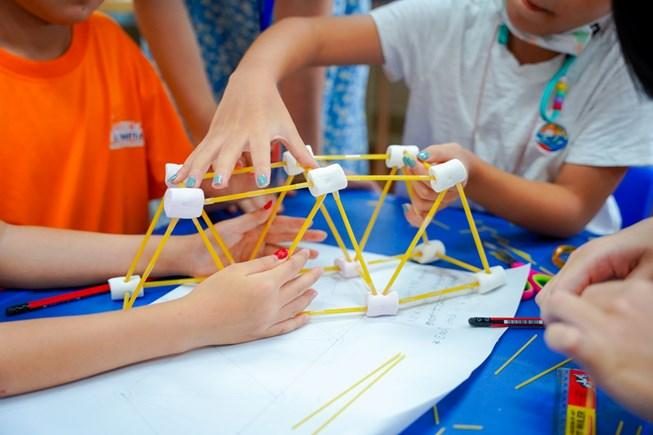
Tension, compression and the spaghetti bridge
In physics, we want to show children tension, compression and the behaviour of structures using things they can hold in their hands. An ordinary piece of spaghetti is very easy to snap by pushing on it, but when we pull it along its length, it is much harder to break. This simple example explains one of the basic principles of structural engineering: structures work according to where compression and tension act. That is why even a simple spaghetti bridge, arranged correctly, can carry a surprisingly large load. What is just an arrow and a force on the blackboard can suddenly be held in your hand and seen with your own eyes.
Heat, cold and good design
We want to explain heat and cold in a similar way. Why does a building overheat in summer? Why does it lose heat in winter? What can proper shading, window orientation, a good building envelope or good design achieve right from the start?
In our view, a good building should not first create a problem and then solve it with technology. The aim is to design so that air conditioning is needed as little as possible in summer (ideally not at all) and heating as little as possible in winter. Examples like these can also show children that physics is not just a school subject, but something that affects our comfort, our energy use and how much a building will cost to run.
When maths turns into material
In maths, area, perimeter and volume turn into very concrete things. The numbers in an exercise book become cubic metres of concrete, square metres of insulation and plaster, metres of waterproofing or a number of bricks. Suddenly it is no longer about whether the answer to an exercise came out right. It is about material that has to be ordered, paid for and used properly. If we make a mistake, we may be short of material or, on the contrary, order more than we need.
We are happy to leave the more complex calculations of tension and compression to the structural engineer. But we should all be able to work out how many square metres a wall has.
Why do we learn at all?
We do not want to turn every child into an architect, a structural engineer or a builder. We want to show them why studying makes sense and that what they learn at school is not cut off from real life. What they learn today in maths, physics or any other subject, they can use tomorrow at work, in business, in research, in technology or in solving problems around them. What matters is understanding that learning gives them tools to understand the world around them better – and later to change it.
Children can change Slovakia
The aim is for children to feel that they can be part of what Slovakia will look like in ten or twenty years. The more young people can think, calculate, create, ask questions and look for solutions, the better our chance of being a country where life is good and which can keep pace with the world.
As the father of two daughters who are still at primary school, I feel this very personally. What they learn today in a primary school classroom, they may one day use to change their town, Slovakia and perhaps even the world around them for the better.
And perhaps the world
Perhaps some of these children will one day become architects, scientists, doctors, programmers, teachers or people who come up with a solution to a problem we do not even know about today. And perhaps one ordinary lesson – where they discover why spaghetti holds more in tension than in compression, or why proper shading can replace part of the air conditioning – will be the moment they understand that learning makes sense.